Is HBOT FDA approved? What “cleared” actually means
Almost every hyperbaric chamber sold in the United States is FDA cleared, not FDA approved. Those are two different legal findings, and the difference is worth understanding before you buy anything.
If you have shopped for a hyperbaric chamber, you have seen the phrase “FDA approved” used freely. It is almost always the wrong phrase, and the correct one tells you something useful.
Cleared and approved are different findings
FDA clears most Class II devices through premarket notification under section 510(k). A clearance is a finding that the device is substantially equivalent to a device already legally on the market. It is not an independent finding that the device is safe and effective.
FDA approves devices through Premarket Approval, which is reserved for Class III devices and does involve a review of clinical evidence for safety and effectiveness.
Hyperbaric chambers sit in the first group. FDA’s Product Classification database lists “chamber, hyperbaric” as regulation number 868.5470, Device Class 2, submission type 510(k), product code CBF (FDA Product Classification, product code CBF). FDA restated it plainly in 2025: “HBOT devices are Class II medical devices and are cleared by the FDA through the 510(k) process” (FDA letter to health care providers, August 25, 2025).
The classifying regulation itself is short. It defines a hyperbaric chamber as a device “intended to increase the environmental oxygen pressure to promote the movement of oxygen from the environment to a patient’s tissue” and classifies it Class II (21 CFR 868.5470).
So “FDA approved hyperbaric chamber” is not a thing. “FDA cleared, product code CBF, under K-number so-and-so” is. If a seller cannot give you the K-number, that is worth noticing.
The conditions FDA listed
FDA published a plain-language list of the conditions hyperbaric chambers are cleared for. Two things to be careful about before quoting it.
First, FDA’s own heading was “Conditions for which hyperbaric chambers are cleared for marketing by the FDA” — cleared for marketing, not approved as treatment. Second, the page was marked content current as of July 26, 2021, and as of this writing the original URL no longer resolves on fda.gov. The list below is quoted from an archived capture of that FDA page, and should be read as of its 2021 date rather than as today’s live position.
- Air and gas bubbles in blood vessels
- Anemia (severe anemia when blood transfusions cannot be used)
- Burns (severe and large burns treated at a specialized burn center)
- Carbon monoxide poisoning
- Crush injury
- Decompression sickness (diving risk)
- Gas gangrene
- Hearing loss (complete hearing loss that occurs suddenly and without any known cause)
- Infection of the skin and bone (severe)
- Radiation injury
- Skin graft flap at risk of tissue death
- Vision loss (when sudden and painless in one eye due to blockage of blood flow)
- Wounds (non-healing, diabetic foot ulcers)
On that same page FDA added: “the FDA has not cleared or authorized the use of any HBOT device to treat COVID-19 or any conditions beyond those listed above.”
The count of thirteen is FDA’s own. A 2013 FDA consumer bulletin said “Thirteen uses of a hyperbaric chamber for HBOT have been cleared by FDA” (FDA Consumer Health Information, August 2013). Be aware that FDA has published the list in two different wordings. A 2013 CDRH letter to state medical boards used clinical terminology and broke out intracranial abscess, necrotizing soft tissue infections and refractory osteomyelitis separately, while the 2021 consumer version compresses those into “infection of the skin and bone” and adds sudden hearing loss (FDA CDRH letter, August 22, 2013). Quote one of them and date it. Do not blend them.
Hyperbaric chambers are prescription devices
This is the part most buyers are surprised by. The classifying regulation does not use the word prescription, but the clearances do, and FDA has said so directly.
Cleared chamber labeling is marked prescription-only. One cleared portable chamber’s indications for use read “to treat acute mountain sickness under the prescription of a health professional” (clearance K220290). A cleared fabric chamber family carries “Caution: Federal Law restricts this device to sale by or on the order of a physician” (clearance K072757). The general prescription-device rule conditions that status on the device being sold only on the order of a licensed practitioner (21 CFR 801.109). And in a 2013 letter to state medical boards, FDA wrote that “hyperbaric oxygen chambers are prescription devices” (FDA CDRH letter).
Soft chambers are narrower than most people think
Low-pressure fabric chambers are frequently marketed as general wellness equipment. The cleared indication on the examples above is far narrower than that, and in one case is acute mountain sickness specifically.
FDA has also been explicit about oxygen: it has not cleared fabric chambers for use with oxygen tanks or oxygen concentrators, and it warned that combining them creates what it called homemade HBOT devices carrying risk of fire and suffocation (archived FDA consumer update).
Fire risk is the reason the rules are strict
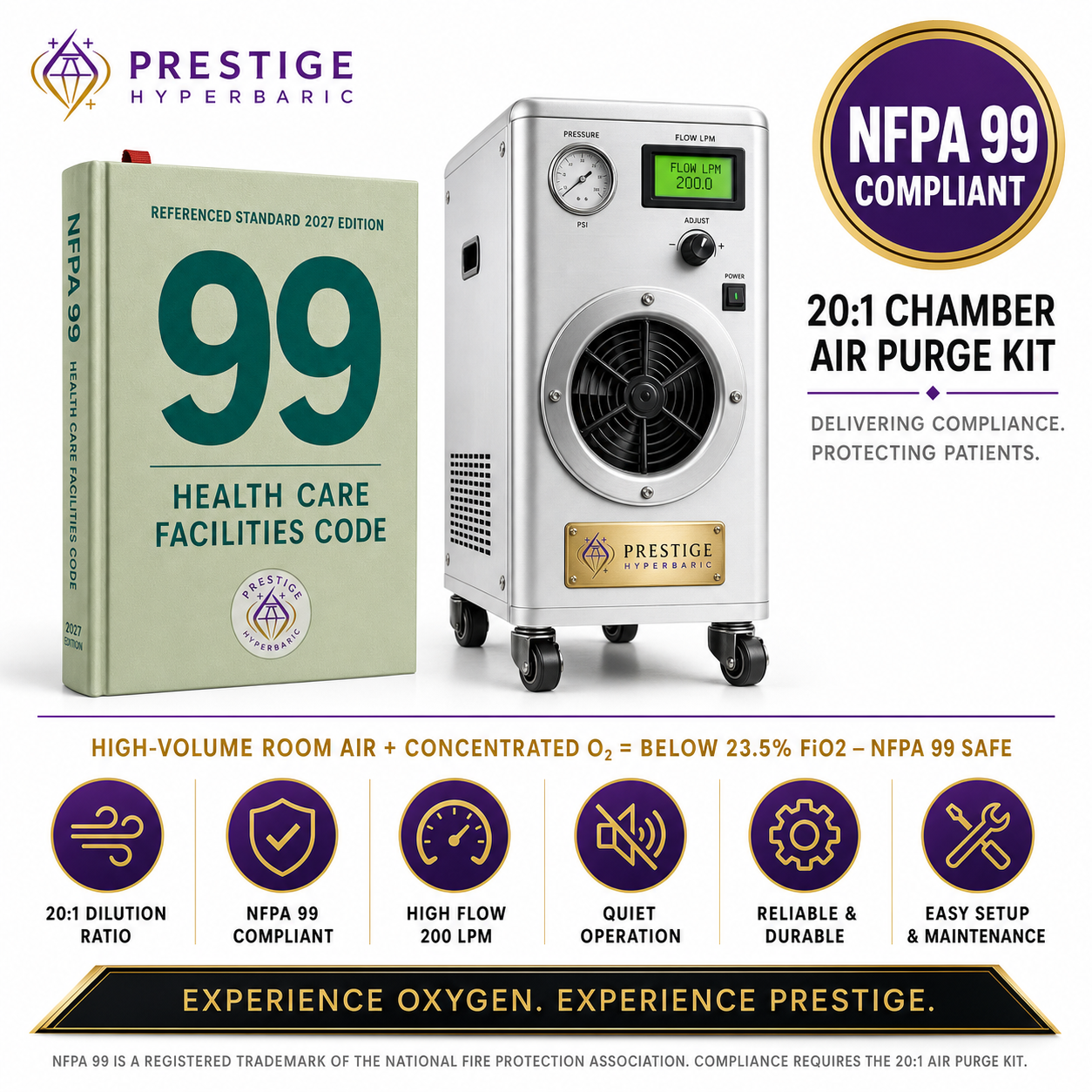
A pressurized, oxygen-enriched space is a fire environment. That is why hyperbaric installations are held to NFPA 99 and why chambers are built to ASME PVHO-1, both of which FDA recognizes as consensus standards for this product code (FDA Product Classification, CBF). FDA’s August 2025 letter to providers reiterated following the manufacturer’s instructions and keeping the occupant monitored and supervised for the duration of a session (FDA, August 25, 2025). If you want the practical version of this, read our notes on electronics and fire risk inside a chamber and on what NFPA 99 Chapter 14 requires.
Uses FDA has specifically flagged as not cleared
FDA has repeatedly named conditions that hyperbaric chambers are not cleared for and that are nevertheless advertised. Across its 2013 and 2021 communications those included cancer, Lyme disease, autism, Alzheimer’s, COVID-19, traumatic brain injury, stroke, multiple sclerosis, Parkinson’s, depression, migraine, asthma and cerebral palsy (FDA 2013; FDA CDRH letter).
Worth knowing if you run a facility or a storefront: FDA treats a seller’s own promotional material as evidence of intended use. In one 2023 warning letter FDA built its case partly from the company’s website links to news articles and journal studies and from its YouTube channel (FDA warning letter, April 4, 2023). Linking to a study is promotion.
What this means if you are buying
- Ask for the K-number and the applicant name, then look it up yourself in FDA’s 510(k) database under product code CBF.
- Read the cleared indication for that specific chamber. Do not accept a general statement about hyperbaric chambers as a whole.
- Treat “FDA approved” on any chamber listing as a signal to slow down and ask more questions.
- Ask whether the unit is built to ASME PVHO-1 and how the installation meets NFPA 99.
- Expect prescription-device paperwork to be part of the conversation.
We sell and service this equipment, so treat this as a buyer’s orientation to the public FDA record rather than as regulatory advice. Every source above is linked so you can read the original. If you want to see chambers running and ask these questions in person, our Holiday, Florida showroom has them set up.
Cited research, not medical advice. Prestige Hyperbaric is a wellness center, not a medical facility, and does not diagnose, treat, cure, or prevent any disease or condition. Nothing here is legal or regulatory advice. Regulatory status changes; the FDA consumer list quoted above was marked current as of July 26, 2021 and its original page no longer resolves.